Keyword Explorer is Now Live; Ask Me Anything About It!
-
Hi Dan - yeah, I think what you're describing makes good sense. You can use the non-geo-specific term to get an idea of broad popularity and in most cases, you'll be able to rank well in your local geography (assuming Google thinks there's local intent) for the broader term with a page targeting the regional one.
e.g. If I search for Patent Attorneys from my office (which is in Seattle), Google biases to show me patent attorneys who are in Seattle. Very similar to the results I get if I search Seattle Patent Attorneys (though some variation is always present).
-
Loving this new Moz Tool!
As a matter of convenience, it would be great to efficiently conduct a backlink analysis of competitors in the SERP Analysis to expediently check their link profile. Can moz link "Linking RDs To Root Domain" to its Open Explorer tool to open up in a new tab the backlink profile of that domain name that is listed in the top 10 organic results? That would be super convenient!
-
Totally agree. We're looking at making it more integrated with OSE very soon. Thanks Gavo!
-
Hi Rand,
In the Netherlands/ Belgium I get no data.. I understand Moz will expand this tool worldwide. Any idea when we can go nuts?
Thanx in advance
-
It will likely be a few months at least before we can broaden outside the US, and maybe some more before we get to non-English languages. Sorry about that! We will get there; just need to do a lot of work to make it happen.
-
Wow this is amazing!! I was day dreaming a while ago about Moz creating a tool like this, you must have read my mind!
 Thank you for the 300 queries per month for legacy $99 members, much appreciated!
Just one bit of constructive feedback, I'm wondering if you should maybe make it more clear (maybe in the more info snippet) that volume is currently all US based? This did have me scratching my head a bit at first, as I'm UK based, and I'd just assumed that when I select UK, the volume would be UK, I realise now that this isn't yet the case.
With regard potential score, how is it able to determine the potential for anything other than US searches given that the volume will be incorrect for anything other than US, and I assume that volume is important when it comes to calculating potential?Also when there is no data for a keyword, how can there be a score for potential since the volume isn't known?
The only other bit of feedback is that there's a lot of "no data" for terms that I can see on my GA stats have hundreds of impressions per month. Is this just because the sites I work on are UK based and these terms probably don't have any searches in the US?
Thanks!
Kev
-
Hi Kev - yeah, totally agree that we need to make that more clear. We'll get to work on that asap.
And yes - Potential takes into account whatever metrics it can; when those are absent (like volume), it uses a low volume bucket (I think 0-10) so as not to overstate. Often when we don't have volume, it's either a very new keyword or a very uncommon one.
And yeah - we don't cover the UK yet, but hope to in the future.
-
Brilliant, thanks Rand

-
Hi Rand
What can non-US Moz customers use until you add UK or AU search volumes? We use the keyword difficulty tool's score and search volume reports quite often.
Would you keep the keyword difficulty tool live until you fix the keyword explorer's search volume?
-
Hi Gyorgy - you can use the old KW Difficulty tool, but the search volumes there aren't accurate for non-US either, and the difficulty scores are less accurate, too. I'd suggest using KW Explorer if you want all the other scores (those are accurate) and AdWords KW Planner in the meantime.
We're prioritizing UK, Canada, and Australia volume data very soon - hopefully will be in the product in the next 60 days.
-
Perfect, I can survive that. Thank you!
PS: the kw difficulty search volume is closer to AdWords than the explorer's US search volume. In a Q&A post I mentioned a head term search volume which has 6-9k searches in AdWords and the kw difficulty tool but 118-300k in kw explorer
-
Yeah - some important things to keep in mind about volume in KWE:
-
It uses United States volume only right now (if you search by default in AdWords, you may be getting global search volume unless you choose "US")
-
It's modifying that data with actual clickstream numbers to give greater accuracy
-
It normalizes trend volume, so if Google has a big spike or dip, they'll show that one number, whereas KWE tries to estimate the monthly average data.
-
-
Hey Rand,
from your blogpost regarding the launch of keyword explorer I got, that you guys are planing to retire the old keyword-diffuculty tool in favor of the new kw-explorer. On the other hand it is stated in that post and here as well, that the new explorer is - and for at least some more month will be - US and english language-centric.
After fiddling with it for a while I get more then > 90% "no data" for volume and many of the new difficulty scores don't make much sense to me (e.g. difficulty scores of < 5 for terms that got a score over >40 in the old tool).
That leads me to two questions:
-
If the new tool is more precise than the old one and the differences in scores are that big: Was it either a terrible idea to use the old scores for decission making in the first place? Or could it be, that the new tool has still some difficulties when it comes to non-english languages or non-us-searches?
-
Related to this: Why retire the old tool so quick if the new one is not an adequate alternative for folks like me yet?
Thanks, Christian
-
-
Hi Christian - can you send over some examples of Difficulty scores that were 40+ and are now <5. That seems very fishy and we can look into it.
In general, the new tool should be vastly more accurate and useful than the old one. Volume data in the old KW Difficulty tool comes from Grepwords, which we'll be using for non-US volume in the new tool as well, hopefully very soon, so you should see that fixed before the old KW Difficulty disappears.
-
Hi Rand,
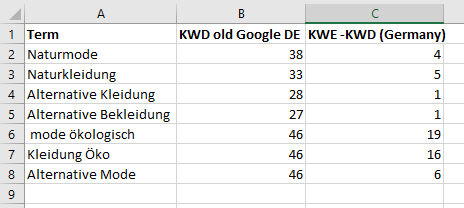
thank you for the quick reply. After looking into the data again, it seems like I have exaggerated a tiny bit. Here are some examples. One of them is old kwd 38, new kwd 4, another one is old kwd 46, new kwd 6. Technically not "40+ to <5" but pretty close and bad enough.
-
Thanks @Chrwald - I'm going to ask Dr. Pete to take a look at these.
-
The new Difficulty score gets pretty aggressively scaled, because we found that the distribution of PA/DA was bunching up a bit, and fell almost entirely in the 25-85 range (looking across an entire SERP). So, a 25 gets scaled down to nearly zero, to give the new metric more granularity.
It looks like the CTR-adjusted PA for "Naturmode" on Google.de (for example) is right around 26, so it may be that the PAs have gone down a bit over time as well. Even by the non-weighted metric, I'd expect that to be a solid 10 points lower than the old difficulty score.
We're going to dig in and try to find out if the rescaling is too aggressive, once we have more data from real-world KWE usage. In general, though, you're going to see a bigger range of difficulty scores with the new metric. It's pretty tough to meaningfully compare the old and new scores.
-
Hi Rand
Love the new KE tool! Great job.
I'm in New Zealand and like others out of the States I also found myself puzzled by the keyword volume estimate, but makes sense now you've clarified these are currently US volumes.
Can you please confirm that, whilst we should ignore the keyword volume estimates for non-US markets, the difficulty and opportunity scores are still applicable outside the US?
Cheers, Mark
-
Hi Mark - yes! If you're using the New Zealand select in the drop down for engines, those other scores should be accurate.
Cheers!
-
how to see the organic keywords that a website uses?








-
 2249
2249
-
0279
-
 1389
1389
-
 14373
14373
-
 04526
04526
-
 0386
0386
-
02388
-
 24380
24380