Wordtracker for keyword volume and Overture PPC for keyword value were my two go-to resources. And WebTrends for the painful process of attempting to figure out what was happening on-site.

Welcome to the Q&A Forum
Browse the forum for helpful insights and fresh discussions about all things SEO.
Wordtracker for keyword volume and Overture PPC for keyword value were my two go-to resources. And WebTrends for the painful process of attempting to figure out what was happening on-site.
Best practices SEO recommendations would dictate eliminating the unique URLs and consolidating to eliminate duplicate content conflict considerations. Never trust Google to "figure it out" when you can instead STRENGTHEN the core product content depth through consolidation.
To keep product pages clean, you can display product variations through CSS enabled tabs, or a host of other methods. (Dropdown menus, for example).
Then, redirect all those variation pages with 301 Redirects back to the new consolidated page version for each core product.
Categories are your primary keyword topics - the primary topical focus grouping of your blog. They should be the umbrellas that contain underneath them, any articles closely related to those highest level topics.
Think of blog categories as the equivalent of main services pages or main product categories in an eCommerce catalog.
In order to build authority and trust for a category topic, you need to build depth of content over time under each umbrella. Indexing category archives is the best method for having search engines recognize that depth of content.
As such, it's vital to allow these to be indexed. Simultaneously, it's unwise to allow indexing of date based archives because those are going to create potential duplicate content conflicts, either partial or entire duplicate representations.
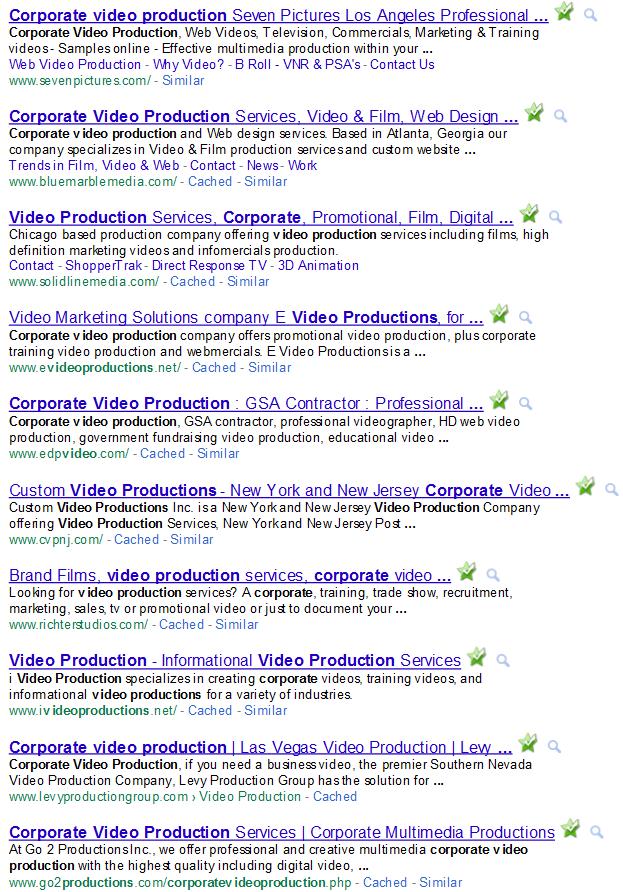
Here's a screen cap. Interestingly, I switched to a few different cities in my Google options, (signed out for all of them) and the top results all remained the same. This tells me there's less "local" correlation for these sites than there is strong non localized SEO factors.
akitmane
Are the errors you see pointing to pages that no longer exist? If that's the case, the best fix that I've found with WP is use of the "Simple 301 Redirects" plug-in for WordPress. It lets you enter the URL of the old page and the URL of a page you want people to go to if they try going to that old URL.
If they're pages that never existed, the question becomes - why are people trying to get to pages that never existed? If they're innocent errors, or links from other sites where the person who made the link made a mistake in the URL, you can either use the Simple 301 Redirects plug-in for those specific links, or contact the site owner of the site that created the flawed link.
Ultimately, you should have a custom 404 page set up (located in the same folder as the theme you're using for your site's template). If that's not working, you will need a WordPress developer or consultant to help you figure out why.
Tustep
I am going to be as honest as possible however harsh it may seem with my answer. If the robots.txt file you included is from your site, that means your site is billstermiteco.com
So:
There could be many reasons this is happening. First and foremost, I can tell you that it looks like you've gotten some extremely bad guidance as far as the concept of SEO goes just by taking a very preliminary look at your site. Whether this specific issue is a primary cause of your problem, a contributing factor, or not is too complex to know this early on however consider this:
You have a main services page called "Phoenix Pest Control". Off of that, you have another page called "Phoenix Pests Control", and right along with that, you have a page called "Pest Control Phoenix".
Wherever you learned or were told that it was good SEO to create three separate pages for the same primary topic, that is a serious problem in 2013 as far as it being a blatant attempt to artificially rank multiple pages for one topic while simultaneously attempting to rank each page for it's perceived "unique" phrase.
Search engines in 2013 are extremely proficient in identifying those three as truly being all so similar as to be considered almost identical in their intent.
From there, I scrolled your services pages and see similar problems where you're wanting to rank for every single town in your service area by loading up on pages that really most likely don't deserve to be ranked based on SEO best practices for a host of other reasons as well.
While I totally understand you are a legitimate business, and you have a valid desire to want to be found for all of your real services and in fact be able to rank regardless of the town, the way you've implemented even just that content tells me that if I were to dig into the rest of your site, or off-site efforts I will quite likely find many other problems of a similarly severe nature.
But lets go further. Your Twitter account is not much more than an artificial link generator for your own site, so the trust signals that could come from Twitter are non-existent.
You have severe page load speed problems - the page I tested took 5.81 seconds to process which means Google is probably seeing similar problems with their crawler speed evaluation. That alone could be half or more of you problem, but when you combine it with what I've mentioned, plus who knows how many other major problems you have, it's no surprise at all that you're getting the results you are now that Search Engines have come as far as they have in their methods and processes.
Site-Wide links are absolutely valid and best practice implementation when they are pointing to a page on your site that is high value. Think of it like this - your main site-wide navigation should point to your highest level product or services page, your "about" page, your "contact" page, and so forth. This is based on user experience. Users should be able to effortlessly get directly to those most important pages. The home page is NOT the only very important page on the site, so why would you hide links to those others?
At the same time, it's NOT best practices to attempt to artificially increase the "perceived importance" of a page that should not be considered that important from a user perspective.
This concept is also about a bigger concern I have with your understanding. If you do not properly set up site architecture to help users, your home page will not get it's maximum value anyhow. And your home page should not, by itself, automatically rank higher for all your primary phrases than those other high level pages should.
Topical separation is vital. I'd suggest having two sections of the site - one devoted to Buick and one to GMC. Each would then have a series of pages within that section devoted to that brand, and where you implement section level navigation - so that each page within that section has a sub-navigation component linking to each other page within that section. Aim inbound links to the top level page within each section as a primary task, and individual pages within each section as a secondary task.
Regardless of whether they're updated or not, RSS feeds are generating duplicate content and not the original source, so the value is going to be either none, or more likely, less than comments on an original source. And if you're actually here asking this question, I'd suggest that unless you perform a specific test, in a specific situation across a specific market niche, you're not always going to get the same results.
And unless you're looking for brute force link building, it seems like a poor time expense to pursue these given the dupe-content factor. And if you are looking for brute force link building, don't rely on this method being sustainable.
You can use various methods to achieve this goal - either as a pop-up or where the text is initially hidden, but then the text area expands for those who want to read more. The critical key is to ensure that whatever method is used has the actual contents of that text directly contained within the source code for the page, and does not instead, pull the text from a separate file. Here's just one example, using pure CSS, no JavaScript (since JavaScript is something Google tries to figure out but is imperfect in doing so).
Ultimately, you'd implement this, then want to test to be sure the end result works so that the content is seen by Googlebot.
Actually it's a bit more complex than Rafi explains.
If the main site is an ecommerce site (sells products), it's okay to have the blog on the main site unless you end up with a high volume of content on the blog that can weaken the "purchase" intent of the main site. In that case, the blog on a sub-domain is actually somewhat better because it separates the "informational" intent out and can in turn build up a stronger authority signal as "informational" as a sub-domain. But only if you drive a lot of traffic, engagement and links to the sub-domain.
If the topic is isolated to a niche topic not generally strong on the main site, that's another valuable reason for the sub-domain path. Again, by isolating it within a sub-domain you're preventing dilution of the topical focus of the main site. That also applies if you have products or services that you can build up enough content within that niche to justify an entire sub-domain.
If the main site is informational and the blog is informational, and there is a lot of cross-topical relationshps, it's best to keep the blog as a folder/directory within the main site - in this scenario you get more value by going this route because of the commonality of intent and topical focus.
To Ben's point, it's not just sanity you'll be saving. You'll be saving your site from multiple pages cannibalizing each others ranking strength. It's much healthier to group them together as long as each individual topic is truly very near identical to others.
Exact match type efforts are great. For a single phrase. Or longer tail phrases off of that. As soon as you want to get ranked for variations that in their sum total require going beyond the exact match, they're not as valuable. Especially if you need to start from scratch.
On the other side of the coin, is all of the content on the existing site high enough quality AND truly relevant to your goals? If it' snot and you need to scrap it, you're going to take a hit on those statistics anyhow.
And on a final note - don't trust the PR numbers alone. They're inaccurate at best, and at least months old. Could very well be that the real PR (not the TBPR you're going by) is lower, especially after Panda/Farmer.
Better to look at the traffic statistics on the site both current and historically compared. If you don't have analytics to review, it's a crap-shoot.
I'd add the critical factor is "will this micro site stand on its own?" Meaning - is there enough unique content, value and trust for this site that it deserves to rank for its own phrases?
If the micro sites share most or all keywords or content as the main site, or if the quality of the micro site is poor, or if it is only filler content purely for liinking, there really is no difference between micro sites and a link network.
So if you want to go the route Charles describes (and I too have used with great success many times for many clients), be willing to achieve those goals. If you think you can "get away" with artificially faking it, you may get away with it for a while. However even if you do, all it takes is one manual review or an algorithm update to wipe out all of that work, and even possibly flag your site in a way that would require four times as much effort to recover.
are they a competitor? If they replaced all the legitimate signals with their own, it's much more likely to be a spam site, or a dirty-tricks competitor or just a dirty-tricks site in general. In that case, I'd demand removal under DMCA and filing with Google for a removal from the Google index.
Marc,
You are correct to think you are missing the opportunity. Here's why:
If it takes x amount of time to optimize for one exact match keyword and that's all your site has, you will have to have x times x work for all of those sites. Direct proportion.
If you build out a deeper site you will gain cumulative value from the work. As individual pages become ranked, that boosts the rank of the whole site over time. It lifts other pages up naturally.
Also, the more you have other similar review content, the more likely people will, over time, explore more info on your site, and some of those will come back to the site as a trusted source.
Then as you promote any one review, via links or social media, the whole site also benefits from that promotion and off-site confirmation.
And it ensures your ability to manage separate sites doesn't completely get out of hand.
Adding in the informational content in its own section of the site (or underneath individual review pages, will just further boost everything as well if the information is tightly related to the umbrella topical focus.
It's kind of like like having a different set of product descriptions for your own site vs. product descriptions you provide to shopping aggregation sites.
Why would you want to give away your best, most current, stuff? If you did, what would motivate people to go to your site? They don't TELL people that, but that's the reality of business.
Personally, I wouldn't try to figure out the impact by looking at crawl stats. I'd be more focused on end results. Have we had an increase in organic traffic, or conversions from Google shopping since we opened it up, or has either of these gone down?
That's what matters, and is the only real indicator as to whether it was a wise move or not.
Caution is the word of the day. Be very cautious about how you link. There are a few options. One of them is NOT to link from the sidebar, header or footer of every page on one site to another site.
Where and how you link depends a lot on the topical focus from site to site. Just because you own them does NOT mean they should be linking to each other. What's the legitimate non-SEO reason? Are they offering similar content or products or services? If they are not, the links won't count enough to even bother most likely. If they are, you can put a link in the footer of the HOME, and maybe an "About" or "Contact" page. Or within the content area of the home page or about page or a main products or services landing page.
I would avoid keyword phrase anchor text if it's a footer link, as that is blatant SEO manipulation and a big red flag now. Instead I would use the domain name as the link.
I believe they are, yes.
Here's another concept. Yahoo's own search results come from Bing. What would be the point of Yahoo displaying the exact same results as Bing though? So it's a known fact that Yahoo takes Bing's data and changes it for the main Yahoo search.
So in that same way, I am saying I believe Yahoo then goes even further and provides yet a different result set for "powered by Yahoo".