Can I canonical the same page?
-
I have a site where I have 500+ Page listing pages and I would like to rel=canonical them to the master page.
Example:
http://www.example.com//articles?p=18 OR http://www.example.com/articles?p=65
I plan on adding this to the section from of the page template so it goes to all pages -
When I do this, I will also add the canonical to the page I am directing the canonical. Is this a bad thing? Or allowed?
-
Josh -
The rel=canonical tag should be used for pages that have virtually identical content.
For example, if your page is:
http://www.domain.com/articles.html... but the page also loads with:
httt://domain.com/articles.htmlThen you'd want to put a rel="canonical" link in the section of the HTML page:
Here's Google's page on the rel canonical tag:
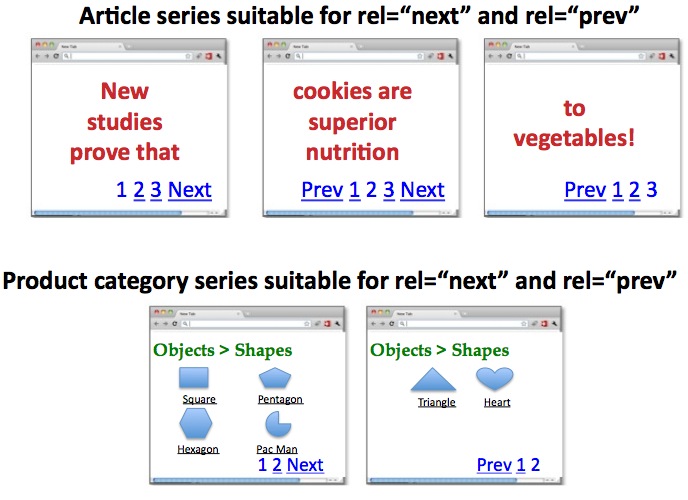
https://support.google.com/webmasters/answer/139394?hl=enWhat it sounds like you have going are multiple pages (Pagination) that list articles, and you should use the rel=prev/next to not have duplicate page content issues.
The recommendation from Moz:
http://moz.com/blog/rel-confused-answers-to-your-rel-canonical-questions
... is to:
Either rel=canonical to a "View All" page (if having all results on one page is viable) or that you use rel=prev/next tag, as described here: http://googlewebmastercentral.blogspot.com/2011/09/pagination-with-relnext-and-relprev.htmlHope this helps!
- Jeff
-
The term "canonical" comes from maths. It means "the standard form to present something in". So, if you have two or more things that are very similar or identical then you might want to say "this is the canonical version - the standard thing we will refer to".
For example, if your CMS is a bit old-school and creates two versions of a page - one human-friendly like example.com/blog-post and another horrible one like example.com?id=12397863294862395 - then you want to point search engines to the nice one and say "this is the standard, canonical version - refer to that one". So in this case you should definitely use on example.com?id=1239786329486239 to give search engines that instruction. If you also add this to example.com/blog-post then that's fine - all you are saying is "this is the standard version of this page" which is perfectly valid.
But from your question, this doesn't sound like your plan. Correct me if I'm wrong, but your plan sounds like you will tell the search engines something along the lines of "you see that blog post there, and that one there, and that one there, and that one over there? They're actually all the same thing, and the standard, canonical page you should refer to is this category page". That wouldn't be a good idea, because all of those articles are different things.
So, I wouldn't add a hard-coded canonical URL into your template. Instead - as long as your CMS allows it - add the canonical tag to the of each article and link to the search engine friendly version of each blog post.



-
 18110
18110
-
 03839
03839
-
 02125
02125
-
 03262
03262
-
 021.3k
-
 04214
04214
-
 04536
04536